

A place for general chat about the Jimny. Please make sure you post in the correct section on the site, this way it keeps the site tidy AND ensures you get a more relevant answer.
Suppliers/Dealers or anyone selling with a commercial view in mind CANNOT post here unless responding to a specific request of a member in a "wanted" post.
Suppliers include people "breaking for spares" on a regular basis, when purchasing spares members should ask a supplier what they contribute to the running of the forum particularly if contacted by a Private Message
Suppliers or Members who have contributed to the forum can be identifed by the
 logo.
Suppliers/Dealers or anyone selling with a commercial view in mind CANNOT post here unless responding to a specific request of a member in a "wanted" post.
Suppliers include people "breaking for spares" on a regular basis, when purchasing spares members should ask a supplier what they contribute to the running of the forum particularly if contacted by a Private Message
Suppliers or Members who have contributed to the forum can be identifed by the
Vacuum hub partially engaging
- jonstaines52@gmail.com
- Topic Author
- Offline
- New Member
-

Registered
Less
More
- Posts: 8
- Thank you received: 0
20 Oct 2026 14:27 #265451
by jonstaines52@gmail.com
Replied by jonstaines52@gmail.com on topic Vacuum hub partially engaging
I have connected a longer hose from the valves to the metal pipes and will tee off from them both so that I can read the vacuum strength from each valve when in action and also to check
if there is any vacuum bypass after the vehicle has stopped and engine turned off as that is the moment when the hub starts to engage the drive . I don't mind buying the parts that are at fault but not replacing them with trial and error.
if there is any vacuum bypass after the vehicle has stopped and engine turned off as that is the moment when the hub starts to engage the drive . I don't mind buying the parts that are at fault but not replacing them with trial and error.
Please Log in or Create an account to join the conversation.


20 Oct 2026 17:39 - 20 Oct 2026 17:46 #265452
by facade
If it suddenly breaks, go back to the last thing that you did before it broke and start looking there
Replied by facade on topic Vacuum hub partially engaging
Are you sure that the noise isn't the hub trying to engage because one of the solenoid vacuum valves is stuck & leaking as Buster is suggesting, and eventually after a bit of running the engine is able to build up sufficient vacuum to pull it in?
It can't pull in at speed, as the axle is stationary but the hub is rotating at speed, so it grinds until you slow down to a crawl. (In normal use, the synchro inside the transfer accelerates the front axle to the same speed as the rear axle before the hubs are triggered so they will just slip over the splines- this is why you have to press the clutch down to stop the rear wheels spinning when you engage 4WD)
Both vacuum valves should be closed to the vacuum line, and vent both hub pipes to atmosphere except for a few seconds when 4WD is engaged/disengaged when the respective valve is powered on and connects the vacuum line from the tank to it's hub pipe.
If you remove the vacuum valves completely, you can squirt a bit of GT85 into the ports and connect the coils to 12V repeatedly to cycle them until they seal properly.
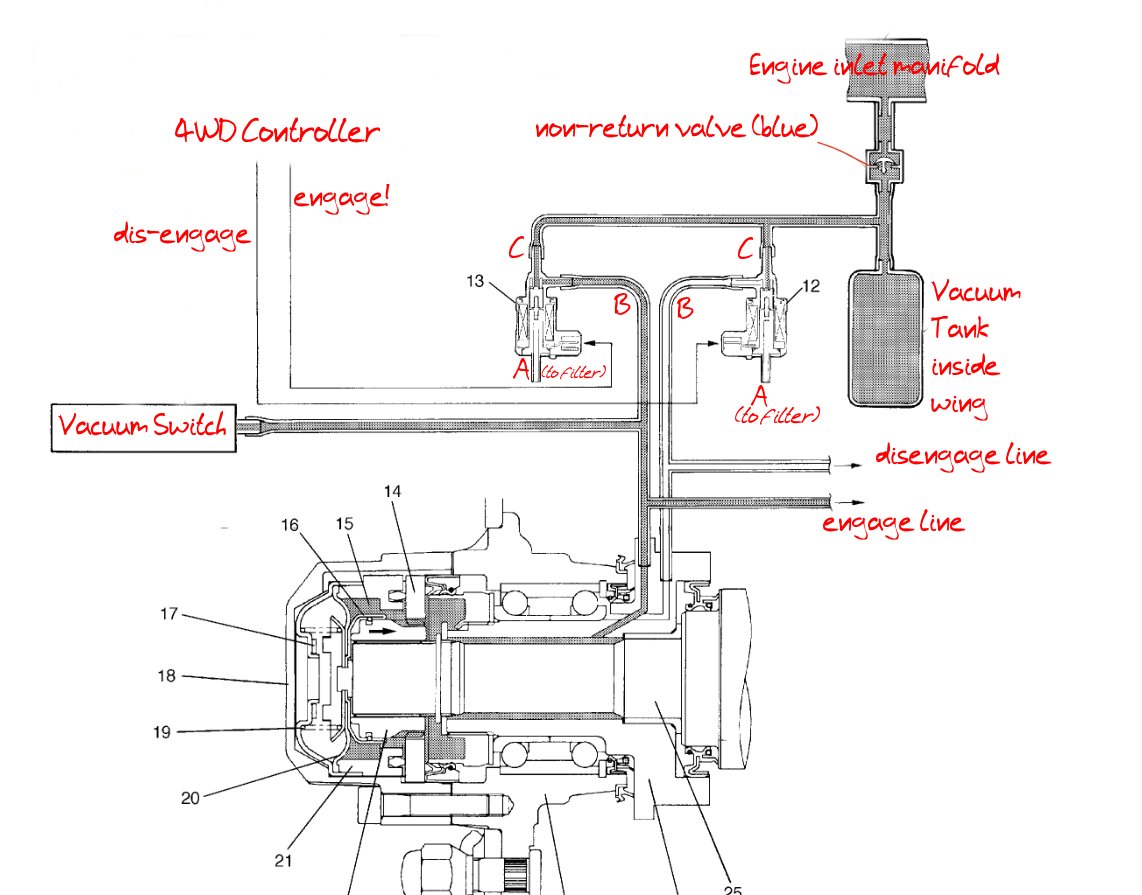
1) check the blue non-return valve in the vacuum line to the inlet manifold. you can suck through it from the engine side, but not the tank side.
2) remove the solenoid valves and test them with 12V and blowing through a tube.
There are 3 ports on each,
A) Fresh air (via a small filter)
B ) vacuum line to hub
C) vacuum line from tank.
Power off: A connects to B and C is sealed off to maintain vacuum in the tank
Power on: B connects to C and the tank vacuum applies to the hub to move it (A could be sealed but it doesn't matter, and I never tested it) The other solenoid lets air into the opposite side of the hub via A-B to push the hub over.
My problem was the disengage valve was stuck and allowed leakage between ports A & C when the power was off, so the tank never built up any vacuum and the hubs wouldn't move I fixed it by squirting GT85 into the ports and operating the solenoid loads of times. They go sticky if someone drives through water and it gets into the vacuum lines either through the hub seals or more likely that little air filter.
It can't pull in at speed, as the axle is stationary but the hub is rotating at speed, so it grinds until you slow down to a crawl. (In normal use, the synchro inside the transfer accelerates the front axle to the same speed as the rear axle before the hubs are triggered so they will just slip over the splines- this is why you have to press the clutch down to stop the rear wheels spinning when you engage 4WD)
Both vacuum valves should be closed to the vacuum line, and vent both hub pipes to atmosphere except for a few seconds when 4WD is engaged/disengaged when the respective valve is powered on and connects the vacuum line from the tank to it's hub pipe.
If you remove the vacuum valves completely, you can squirt a bit of GT85 into the ports and connect the coils to 12V repeatedly to cycle them until they seal properly.
1) check the blue non-return valve in the vacuum line to the inlet manifold. you can suck through it from the engine side, but not the tank side.
2) remove the solenoid valves and test them with 12V and blowing through a tube.
There are 3 ports on each,
A) Fresh air (via a small filter)
B ) vacuum line to hub
C) vacuum line from tank.
Power off: A connects to B and C is sealed off to maintain vacuum in the tank
Power on: B connects to C and the tank vacuum applies to the hub to move it (A could be sealed but it doesn't matter, and I never tested it) The other solenoid lets air into the opposite side of the hub via A-B to push the hub over.
My problem was the disengage valve was stuck and allowed leakage between ports A & C when the power was off, so the tank never built up any vacuum and the hubs wouldn't move I fixed it by squirting GT85 into the ports and operating the solenoid loads of times. They go sticky if someone drives through water and it gets into the vacuum lines either through the hub seals or more likely that little air filter.
If it suddenly breaks, go back to the last thing that you did before it broke and start looking there
Last edit: 20 Oct 2026 17:46 by facade.
The following user(s) said Thank You: jonstaines52@gmail.com
Please Log in or Create an account to join the conversation.
- jonstaines52@gmail.com
- Topic Author
- Offline
- New Member
-
Registered
Less
More
- Posts: 8
- Thank you received: 0
20 Oct 2026 18:46 #265453
by jonstaines52@gmail.com
Replied by jonstaines52@gmail.com on topic Vacuum hub partially engaging
I think you quite possibly correct,
tomorrow morning before starting I will jack up the wheel to check it has not engaged the font prop then attach the vac gauges before starting the engine to check vac bypassing and also see if the hub is trying to engage.
But I think your suggestion that the hub is partially engaging with bypassing vacuum could be the cause.
Please Log in or Create an account to join the conversation.
- jonstaines52@gmail.com
- Topic Author
- Offline
- New Member
-
Registered
Less
More
- Posts: 8
- Thank you received: 0
22 Oct 2026 12:57 #265469
by jonstaines52@gmail.com
Replied by jonstaines52@gmail.com on topic Vacuum hub partially engaging
I left the car overnight and in the morning before setting off I disconnected the hub vacuum pipes, bingo no problems of partial engagement when I drove away. This may mean the hub only tries to engage after the engine starts .
Please Log in or Create an account to join the conversation.
- jonstaines52@gmail.com
- Topic Author
- Offline
- New Member
-
Registered
Less
More
- Posts: 8
- Thank you received: 0
22 Oct 2026 15:59 #265470
by jonstaines52@gmail.com
Replied by jonstaines52@gmail.com on topic Vacuum hub partially engaging
Update.
All valves work fine and all pipes hold vacuum, I fitted temporary test points for the vacuum lines.
As stated if I disconnect the vacuum with the hubs set for 2wd (disengaged). Then from cold with start up there are no problems .
If I reconnect the vacuum then in the morning then the n/s hub is partially engaged.
What I have found and not sure if it's normal is when starting the car from cold the disengage valve opens to full vacuum for 10 secs,
then driving away the n/s hub has partially engaged.
Concluding that applying vacuum causes the hub to partially engaged and if I slow down to almost a stop and apply a slight turn to the left the hub clunks and the magent is strong enough to pull the splined cog out of engagement .
So my problem may be in the hub itself as the vacuum does not not seem to be able to disengage completely , in fact it seems to partially engage the hub. Any ideas?
Please Log in or Create an account to join the conversation.
22 Oct 2026 18:47 - 22 Oct 2026 18:49 #265471
by facade
If it suddenly breaks, go back to the last thing that you did before it broke and start looking there
Replied by facade on topic Vacuum hub partially engaging
I didn't know for sure, but it makes perfect sense for the ecu to try to force the hubs into the requested position to match the transfer lever as soon as the engine starts (well I'd give it a few seconds to build up some vacuum, but Suzuki might think that the tank stays full (empty  ) and go for it straight away- you could have switched off in 4WD and moved the lever to 2WD before you start up again.
So applying vacuum to the disengage line for 10 seconds sounds correct.
What I'd do now is go for a drive with it grinding, slow down until it clicks and stops grindng, then carefully take the hub off on the offending side and see if it is engaged. (actually, I'd take both off and see what both hubs are doing)
I can't see why it would keep trying to engage unless there is a vacuum leakage at the valve, and why it only affects one side.
The pipes aren't crossed over on that hub are they?
) and go for it straight away- you could have switched off in 4WD and moved the lever to 2WD before you start up again.So applying vacuum to the disengage line for 10 seconds sounds correct.
What I'd do now is go for a drive with it grinding, slow down until it clicks and stops grindng, then carefully take the hub off on the offending side and see if it is engaged. (actually, I'd take both off and see what both hubs are doing)
I can't see why it would keep trying to engage unless there is a vacuum leakage at the valve, and why it only affects one side.
The pipes aren't crossed over on that hub are they?
If it suddenly breaks, go back to the last thing that you did before it broke and start looking there
Last edit: 22 Oct 2026 18:49 by facade.
The following user(s) said Thank You: jonstaines52@gmail.com
Please Log in or Create an account to join the conversation.
Time to create page: 0.244 seconds